Product Schema Was Always The Bigger Win: E-commerce After Google Retired FAQ Rich Results

For two years, e-commerce sites split structured-data effort between Product schema and FAQPage schema. Google retired the FAQ side of that investment in August 2023. The Product side became the only side that mattered. Most e-commerce SEO playbooks still describe both as equally important. They are not.
The 2023 retirement, briefly
Google announced that FAQ rich results would no longer appear in standard SERPs as of August 2023, with a narrow exception for authoritative government and medical institution sites. Search Engine Land confirmed the rollout. E-commerce (even premium DTC, even high-DR retail brands) did not qualify for the exception. The schema still validates. The dropdown does not appear.
What this means for e-commerce specifically: the structured-data lever that was always doing the work for product visibility (Product schema) kept doing the work. The lever that was getting attention without earning it (FAQPage schema on collection pages) stopped paying.
Why FAQ schema looked good for e-commerce in 2021-2023
In our experience auditing DTC and mid-market e-commerce sites between $2M and $50M revenue, the appeal of FAQ schema on category and PDP-adjacent pages was specific: it produced visible SERP estate without requiring perfect product feed hygiene. A Shopify site with messy variant SKUs, missing GTINs, and no Merchant Center integration could still ship FAQ schema in a weekend and get the SERP dropdown. Product schema was harder to get right and the consequences of getting it wrong were ugly.
Then the dropdown went away. The hard work (Product schema with valid gtin, availability, aggregateRating, and offers) became the only work.
The four schema priorities for e-commerce in 2026
1. Product schema, configured against a real product feed
Product schema is the single biggest structured-data investment for any e-commerce site. The 2026 SERP rewards a fully populated Product entity with:
- Star ratings on product result cards (via
aggregateRating) - Price and availability in the result snippet (via
offers) - Eligibility for merchant listings in Google’s free product results (separate program, but same schema)
- Inclusion in Google Shopping panels for branded and category searches
This requires the product feed to be honest. A gtin field stuffed with placeholder values voids eligibility. An availability field that says “InStock” when the SKU is back-ordered triggers a manual action.
We covered the product-page mechanics in our guide to product page SEO. Schema is the multiplier on top of clean PDP architecture.
2. Review schema, anchored to verified review data
Review schema only earns rich result eligibility when the review data is verifiable: first-party Yotpo, Reviews.io, Trustpilot integrations that surface real review text into the page DOM. Manually entered “5 stars from happy customers” review schema has been a manual-action target for two years. In 2026, AI Overviews also prioritise sources with verifiable review markup when picking which retailer to cite for product comparisons.

3. CollectionPage and BreadcrumbList for category architecture
Category pages (the backbone of e-commerce organic traffic) benefit from CollectionPage schema with a populated mainEntity and BreadcrumbList for the category hierarchy. This combination produces the cleanest SERP path display and signals collection-level intent to AI Overviews when buyers ask “best winter jackets under $200” type queries.
| Page type | Primary schema | Secondary schema | What it earns in 2026 |
|---|---|---|---|
| Product detail | Product | Review, Offer | Star ratings, price snippet, Merchant Listing eligibility |
| Category | CollectionPage | BreadcrumbList | Clean path, AI Overview comparison eligibility |
| Brand homepage | Organization | WebSite | Knowledge Panel, sitelinks search box |
| Cart / checkout | None (noindex) | n/a | Not a search surface |
| Blog content | Article / BlogPosting | n/a | Top Stories, news-tab eligibility |
| FAQ on PDP | FAQPage | n/a | AEO citation only (no SERP visibility) |
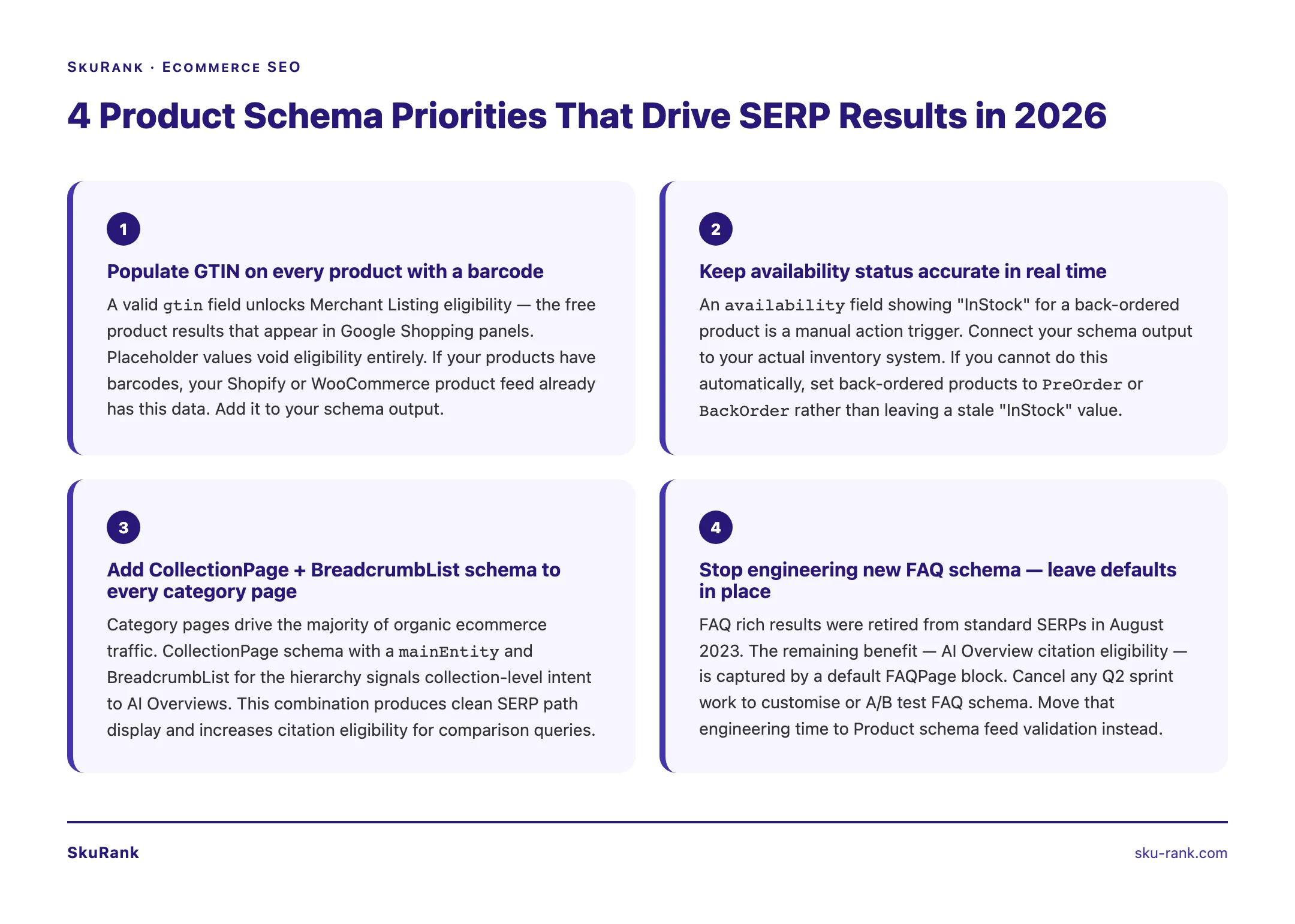
4. Stop investing in FAQPage schema as a primary effort
The schema can stay. Configuring it past defaults is now a poor allocation of engineering time. AI Overview citation eligibility (the remaining benefit) is captured by a default-configured FAQPage block on existing FAQ content. Custom configuration, JSON-LD validation cycles, A/B testing FAQ question order: none of this earns SERP visibility in 2026.
If your e-commerce SEO sprint backlog has FAQ schema work scheduled for Q2, cancel it. Move that engineering time to Product schema feed validation. We compared the SEO tools that actually move the needle for e-commerce. Most of the schema-validation tools still flag FAQ issues with high priority, which is now misleading.
If your Shopify, WooCommerce, or BigCommerce store is still treating FAQ schema as a structured-data priority alongside Product schema, the audit we ship in week one of every SkuRank engagement re-prioritises this, usually with measurable result-card improvements within 30 days.
The full architecture is in our pillar on top e-commerce SEO companies and the broader SkuRank approach to e-commerce content strategy.
FAQ
Should I delete FAQ schema from my product pages? Treat this as an engineering-time prioritisation question, not a delete-or-keep one. The existing FAQ schema stays in place (the default block still earns AI Overview citation eligibility for question content on those pages), but reallocate every spare hour of structured-data effort to Product schema: feed validation, GTIN coverage, accurate availability, and offers data. That is where 2026 SERP value is created.
Does the FAQ exception apply to health or supplement e-commerce? Almost certainly not. The exception is limited to authoritative medical institution sites (Mayo Clinic, NHS, peer-reviewed journals). A commercial supplement, vitamins, or wellness e-commerce site does not qualify regardless of medical content depth or domain authority.
Will Product schema rich results disappear too? There is no signal from Google that Product schema rich results are being narrowed. The opposite: Merchant Listing eligibility expanded in 2024 and 2025. Investing in Product schema is the safe direction.